

A bright, beautiful smile is often seen as a sign of confidence and good health. When someone loses a tooth, it can affect not only their appearance but also their ability to chew, speak, and smile comfortably. Missing teeth are more common than many people realize. According to the American College of Prosthodontists, over 120 million Americans are missing at least one tooth. Understandably, patients often wonder if dental veneers can be a solution.
In this blog, we’ll explore whether veneers can replace missing teeth, what options are available for those gaps, and what role veneers actually play in dentistry.
What Are Dental Veneers?
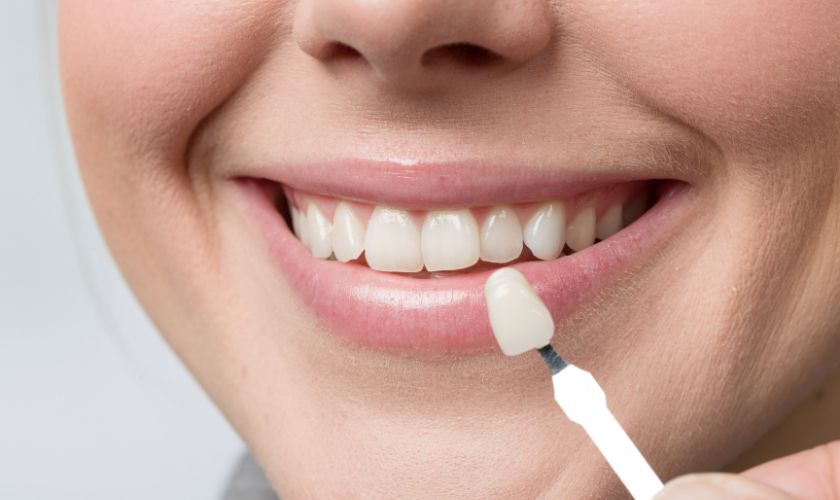
Dental veneers are thin shells of porcelain or composite resin that are bonded to the front surface of natural teeth. They are primarily used for cosmetic purposes—to improve the shape, size, color, or alignment of teeth. Veneers are a popular choice for patients dealing with:
- Stained or discolored teeth
- Chipped or cracked teeth
- Minor gaps or uneven spacing
- Slightly crooked teeth
Since veneers only cover the visible part of the tooth, they require a healthy underlying natural tooth structure to bond securely.
Can Veneers Replace Missing Teeth?
The short answer: No, dental veneers cannot replace a missing tooth.
Because veneers are designed to cover existing teeth, they need a tooth structure as a foundation. If a tooth is missing entirely, there is nothing for the veneer to attach to. This makes veneers unsuitable as a standalone replacement for lost teeth.
That doesn’t mean veneers are useless if you have missing teeth. Often, they’re part of a bigger treatment plan. For instance, after a tooth extraction treatment, a dentist may recommend replacing the missing tooth with an implant, bridge, or partial denture. Veneers may then be used on surrounding teeth to create a uniform, natural look and enhance the overall smile.
Alternatives to Veneers for Missing Teeth
If you’re missing one or more teeth, a dentist will likely recommend other restorative options such as:
1. Dental Implants
- Titanium posts are surgically placed in the jawbone that act as artificial roots.
- Topped with dental crowns that look and function like real teeth.
- Considered the gold standard for long-lasting, natural tooth replacement.
2. Dental Bridges
- A row of artificial teeth supported by adjacent natural teeth or implants.
- Bridges literally “bridge the gap” left by one or more missing teeth.
3. Partial or Full Dentures
- Removable appliances that replace missing teeth and restore bite functionality.
- Usually recommended for people missing multiple teeth.
Once a missing tooth is replaced with one of these treatments, veneers may still be used on nearby natural teeth to create a seamless consistent smile.
When Veneers Make Sense After Missing Teeth Replacement
Imagine you’ve lost a front tooth due to trauma. After getting a dental implant to fill the gap, your dentist notices that your other front teeth are slightly discolored or uneven in shape. In this case, veneers can be placed on the natural teeth next to the implant crown to ensure all the front teeth match perfectly.
This combination approach delivers both functional tooth replacement and cosmetic enhancement.
Benefits of Considering Veneers Alongside Other Treatments
- Natural Aesthetics – Veneers help create symmetry by matching the shade and shape of new crowns or bridges.
- Minimal Invasiveness – Veneers require less enamel removal compared to crowns.
- Durable Beauty – Porcelain veneers can last 10–15 years with proper care.
- Smile Transformation – They address discoloration, chips, and size differences around the replacement tooth.
Consultation: The Key First Step
Before deciding on veneers – or any restorative option – it’s essential to schedule a thorough consultation with a dentist. Your treatment will depend on factors like bone density, gum health, budget, and cosmetic expectations. A dentist can help you design a plan that restores both function and beauty to your smile. Don’t hesitate to book an appointment to explore your personalized options.
FAQs About Dental Veneers for Missing Teeth
1. Can veneers be used to replace an entire missing tooth?
No, veneers require an existing tooth structure to attach to. They cannot replace a tooth by themselves.
2. What’s the best option for replacing a missing tooth?
Dental implants are widely considered the gold standard because they provide durability, function, and a natural appearance.
3. How are veneers and crowns different?
Veneers only cover the front surface of the tooth, while crowns cover the entire tooth. Crowns are often used after tooth replacement treatments like implants or bridges.
4. Can veneers be combined with dental implants?
Yes, veneers can be used on natural teeth adjacent to implants to create a consistent and natural-looking smile.
5. Are veneers permanent?
Yes, placing veneers requires removing a thin layer of enamel, which is irreversible. However, with good care, porcelain veneers can last over a decade.
6. Do veneers protect against cavities?
No, veneers only cover the front surface. You still need to practice good oral hygiene to prevent cavities and gum disease.
7. How long does it take to get veneers?
Typically, veneer treatment takes 2–3 visits over a few weeks, depending on whether the dentist uses porcelain or composite resin.